Free tool
How long until you can do a pull-up?
Answer the questions below and this calculator runs Overbar’s own forecast, the one the app uses. You get an estimate in weeks with its likely range, how pull-up ready you are today and the stage you’d start in. For beginners it’s anywhere from 2 to 12 months. It’s an estimate, never a promise.
Your answers
Your first pull-up, in about
24 weeks
Likely between 14 and 46 weeks, at 3 days a week.
One more day a week brings it to about 21 weeks.
You’d start in Grip & Hang, about 35% pull-up ready.
An estimate. In the app, Day 1 measures you instead of guessing, and your date moves after every workout.
Get your own dateA few more, for a closer estimate
The app’s own forecast, from your answers and published training research. Everything runs in your browser: nothing you enter is sent or saved.
How does the calculator work it out?
It runs the same forecast as the app, ported line for line. Your answers set where you start, as a share of your body weight you could pull. Your days, minutes, kit, age and any joint pain set how fast you’re likely to improve, about 3% a week at first, easing off over the months. The estimate is the week that strength reaches one pull-up, plus a few days to try it. The full method, with its sources and which parts are design choices, is on How Overbar works out your date.
What moves your date the most?
Where you start, then how often you train. With the same answers (a woman, 29, hanging 10–29 seconds, a few push-ups, a bar), the estimate moves like this:
| Change | Estimate |
|---|---|
| 3 days a week, 15 minutes (the start) | about 27 weeks |
| 2 days a week | about 33 weeks |
| 4 days a week, 20 minutes | about 21 weeks |
| A bar and bands | about 25 weeks |
| A gym | about 23 weeks |
| Age 45 | about 34 weeks |
| Age 55 | about 35 weeks |
More days help because they add up to more training in a week (Grgic 2018), and short sessions count: four 15-minute sessions matched two hour-long ones (Kilen 2020).
Why is the range so wide?
Because people improve at different speeds, and a quiz can’t see yours. The range is the same forecast at a slower and a faster pace. The slow end often reaches a year; that’s the honest edge of a guess. In the app, the range narrows as your check-ins show your real pace.
What the calculator can’t know
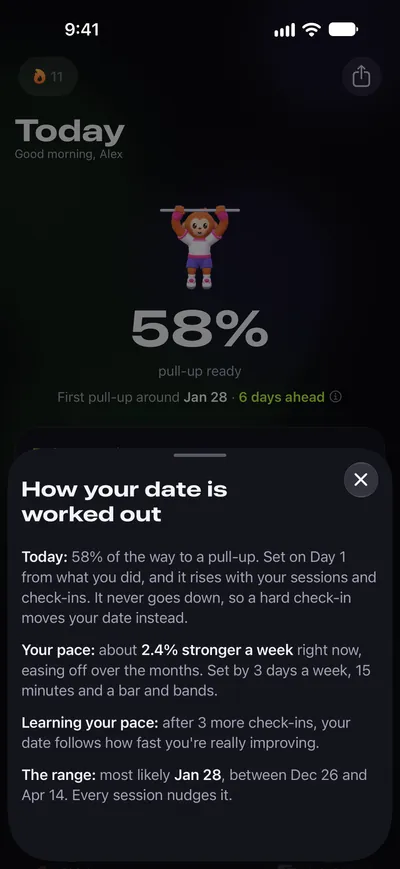
How long you can hold your chin over the bar, or how slowly you can lower yourself. Those two predict a first pull-up better than anything in a quiz, and only a bar can measure them. That’s what Day 1 in the app does, free: it times your hang, top hold, slow lower and rows, and sets your plan and date from what it finds. A check-in every two weeks measures you again.
Is my data stored?
No. The calculator runs in your browser. Your answers aren’t sent anywhere or saved, and there’s no sign-up.
Questions
How accurate is the first pull-up calculator?
It’s an estimate from your answers, with its likely range. It uses the same forecast as the Overbar app and published training research, but it can’t measure you. In the app, Day 1 measures your hang, hold and lower, and the date updates after every workout.
Why does it ask whether I’m female or male?
Only to tune where the estimate starts, and it’s optional. On average, women start with less upper-body strength relative to body weight, and they build relative strength at least as fast as men. Sex never changes how fast the forecast expects you to improve.
Why does it ask my height and weight?
A pull-up lifts your whole body, so they adjust where the estimate starts. They’re optional, never stored and never sent. They don’t change how fast the forecast expects you to improve.
I don’t have a pull-up bar. What does the result mean?
It’s how many weeks you’d need once you have a bar. A strict pull-up needs one, but you can start without it: rows under a sturdy table, door towel rows and floor work build the same pulling muscles.
Can I really do a pull-up in 30 days?
Only if you’re already close: say, you can lower yourself slowly from the top, or you did pull-ups a few years ago. From never having done one, the fastest start in this forecast is about 10 weeks (6 at the fast end), and typical starts take months.
Why does the date in the app differ from this one?
Because the app measures you. Day 1 replaces the quiz’s guess with your real hang, hold and lower, up or down, and every session after that moves the date.
Turn the estimate into a plan.
Overbar measures you on Day 1, builds the six stages around your week, and moves this date after every workout. Day 1 and Quick Hangs are free; Pro is $49.99 a year with a free week, or $5.99 a week.
Download on the App Store