Free tool
Dead hang test: how long can you hang?
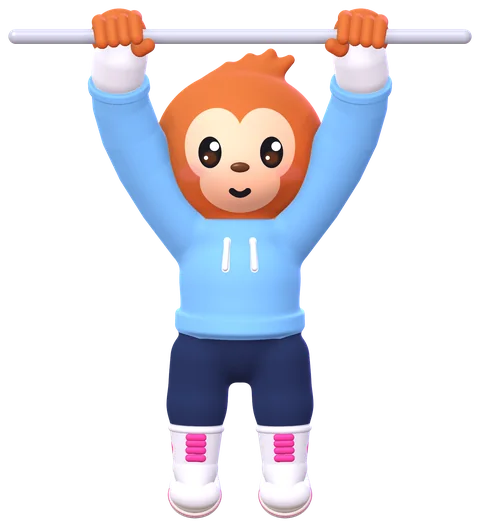
Hang from a bar with straight arms and your feet off the floor, and time how long you hold on. Under 10 seconds, start with short hangs and rows. About 30 seconds is when coaches move people on to harder pulling. There are no validated norms by age, so compare each try with your first.
Time your hang
Prop your phone where you can see it. Tap Start, step off the box on “Hang”, and tap Stop when you let go. Step down, don’t drop.
The timer needs JavaScript, but any stopwatch works: start it as your feet leave the box, and stop it when you let go.
What your time means
Under 10 seconds: Foundations. 10 to 29 seconds: Grip & Hang. 30 or more: Top Holds, where you hold your chin over the bar.
How to do the dead hang test
- Warm up for a minute or two: arm circles, shoulder rolls, reach-ups.
- Grip the bar overhand, hands about shoulder width, thumbs wrapped round it.
- Step off a box or step, so you start still. Arms straight, legs relaxed, breathe.
- Hang until you let go or your hands start to slip.
- Step down, don’t drop.
One try is the test. Do it again in two weeks, at the same time of day, on the same bar.
What does your time mean?
It tells you where to start. Coaches take a 30-to-60-second hang as the first sign you’re ready for harder pulling (Beecroft), and Overbar’s plan uses the same steps:
| Your hang | Where Overbar’s plan starts you (with a bar) |
|---|---|
| Can’t hang, or under 10 seconds | Foundations: rows, a tight core, short hangs |
| 10–29 seconds | Grip & Hang: hangs, hanging shrugs, rows |
| 30 seconds or more | Top Holds: chin over the bar, then halfway |
How long should you be able to dead hang before a pull-up?
About 30 seconds is the first marker, but a long hang isn’t a pull-up. Hanging trains your grip and your shoulders’ comfort at the bottom; a pull-up also needs strength at the top and all the way between. That’s why even a one-minute hang starts at Top Holds, not at the full pull. The next markers are a 15-second hold with your chin over the bar, then lowering yourself slowly for 5, then 10 seconds.
Is there a dead hang chart by age?
Not one you can trust. We found no validated dead hang norms by age or sex, and the “dead hang time by age” tables online disagree with each other. Grip strength does change with age: it peaks between about 26 and 42 and declines from midlife (Dodds 2014). The nearest real standard is for a different test: researchers separated trained from untrained college women at a 5-second flexed-arm hang, chin over the bar (Rutherford & Corbin 1994). For a dead hang, the useful comparison is you, two weeks ago.
Is dead hanging good for you?
It builds your grip and gets your shoulders used to hanging, which is why it’s day one of every pull-up plan. You’ll see claims that hanging fixes posture, decompresses the spine, makes you taller or predicts how long you’ll live. The studies we use don’t support them, so we don’t make them.
How do you get a longer hang?
Hang often, in short sets, and stop before your grip gives out.
- 3 to 5 hangs of 10–30 seconds, a minute or two apart, two to four days a week.
- Hanging shrugs: arms straight, pull your shoulders down from your ears, pause, lower. 2–3 sets of 5–10.
- Feet-assisted hangs if you can’t hold on yet: toes on a box, take as much weight off as you need.
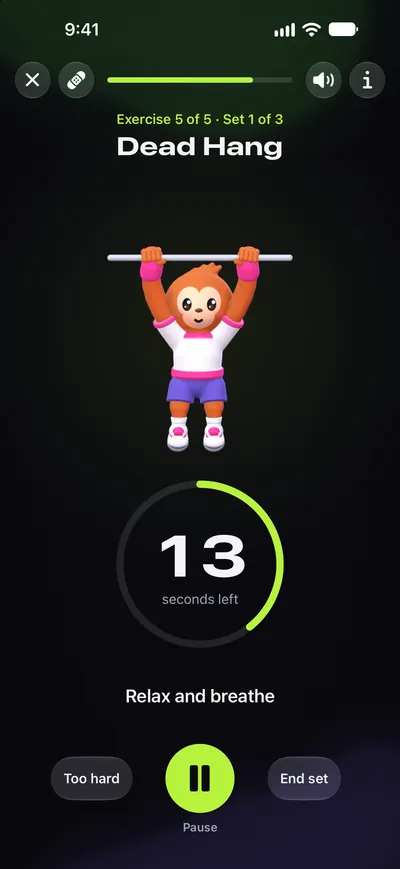
- A little every day: in the app, Quick Hangs are a couple of minutes of timed hangs, free, and they keep your streak.
Install a doorway bar exactly as its maker says and check it each time. Never hang from door frames, door tops or shelves. Step down from the bar; don’t drop. This is general fitness guidance, not medical advice: with shoulder, elbow or wrist pain, or after an injury, talk to a doctor or physiotherapist first.
Questions
How long should I be able to dead hang?
There’s no validated norm by age or sex. As a training marker, coaches take 30 to 60 seconds as the first sign you’re ready for harder pulling. Under 10 seconds is a fine place to start: hangs get longer quickly with short, frequent sets.
How long should I dead hang before I try a pull-up?
Aim for about 30 seconds, then build strength at the top: a 15-second hold with your chin over the bar, then slow lowers of 5 and 10 seconds. A long hang alone isn’t enough for a pull-up.
Is a 1-minute dead hang good?
Yes, it’s a strong grip. It means your hands won’t stop you; your next steps are the top hold and slow lowers.
Is there a dead hang time chart by age?
Not a validated one. The charts online disagree with each other, and we found no study that set dead hang norms by age. Compare your time with your own first try instead.
How often should I do dead hangs?
Two to four days a week in short sets, or a couple of minutes most days. Stop each hang before your grip gives out completely.
What’s the difference between a dead hang and an active hang?
In a dead hang your shoulders relax up towards your ears. In an active hang you pull them down and back while your arms stay straight. Moving between the two is the hanging shrug, the first inch of every pull-up.
Hang every day, free.
Overbar’s Quick Hangs are a couple of minutes of timed hangs that keep your streak, and Day 1 measures your hang, hold and lower to build your plan. Pro is $49.99 a year with a free week, or $5.99 a week.
Download on the App Store